Thursday, 30 March 2017

Self-driving truck hits the road in the US to deliver 50,000 cans of Budweiser

I wanted to include this case study because it still has part to the theme of a self-automated system and I thought it would still be interesting to have a different case scenario.

Self-driving beer delivery truck
Self-driving truck, 2016

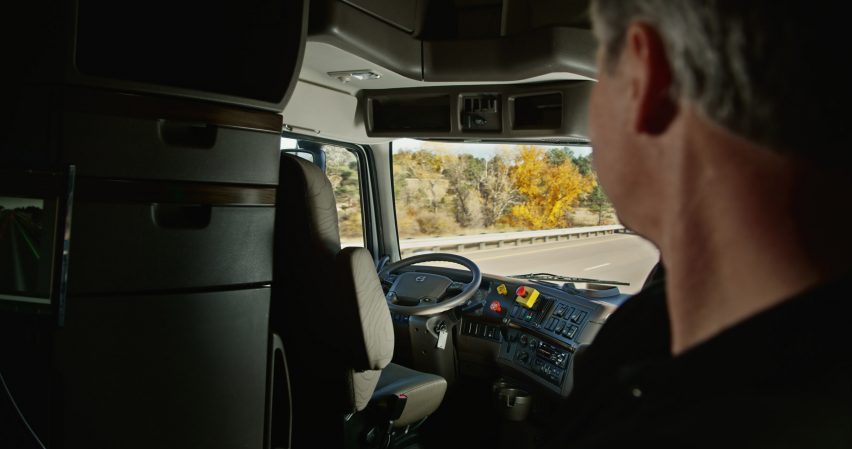
This concept has successfully been achieved to its intention on delivering 50,000 cans of Budweiser with a self-driving truck with a journey of 120 miles long in the United States. It is stated that it is the world first company commercial shipment by a self-driving truck. (Alice Morby, 2016)

Budweiser, Otto Self-Driving truck 2016 

For the whole route the vehicle has functioned well autonomously for its entire way. For this operation success, the companies are now aiming to invest and develop into more functioning self-driving freight system.


I have included this successful autonomous tested vehicle, as a result of achievement towards the self-automated function. Although this function will not be used for my further study accomplishment of my dissertation, I still wanted this reference of a self-functioning system to be in my records.

Something that keeps me back from trusting the service system of a self-driving shipment, is that it might loose its automated system and cause any harm or damages that can involve the risk of other people's lives.


Reference:

Alice Morby, 2016. 'Self-driving truck hits the road in the US to deliver 50,000 cans of Budweiser'. Available on: <https://www.dezeen.com/2016/10/26/self-driving-delivery-truck-otto-budweiser-driverless-vehicle-design-transport-technology-colorado-usa/> [Accessed on 30th May 2017 ]

Monday, 27 March 2017

Floating City concept by At Design Office features underwater roads and submarines

Looking at a different proposal project, it declares the profession of thinking broadly or rather more creative that leads to enhancing the achievement of developing something further in our lives.


Floating City Concept by AT Design Office 


The concept of a floating city in an ocean metropolis was an alternative idea that could resolve the problem from the overcrowd in China. The At Design Office have dealt with a Chinese Construction company CCCC to design a floating island that would be built from prefabricated hexagonal modules. (Architecture & Design, 2014)

The floating island area would take four square miles. As a construction work it was thought to be built the same way on how the Chinese Construction company CCCC have build the 31 miles bridge between the cities of Hong Kong, Macau and Zhuhai.  (A.Frearson, 2014)

The floating city concept features, underwater roads and submarines. The concept continues by  defining more details which consist the working system of how this project can be possibly achieved.


Floating City by AT Design Office

As the architectural reporter Amy Frearson, declares that the transportation can work through a networking system of yachts and submarines. In the city of the floating concept includes a floating hotel, entertainment complex, recreation of green spaces both above and below the water's surface.

Farming and hatchery will also be accessible, and for rubbish collection it would allow the community to produce its own food and sustainability dispose of waste. (A.Frearson, 2014)

Another intriguing key for this concept, Siska said that the project may be developed further to obtain energy efficiency and self sufficiency for a new urban nucleus of world class residential, commercial and cultural facilities.

Overall the concept design of a floating city, is quite extraordinary, extensive and different from other projects that I have gone through. Yet, I see a potential at certain elements that are reliable. The most captivating system that interested me, were the vertical farms and fish hatcheries that will be produced on the island, as well as the trash dispose will be sustained in their own waste.

I think if the system and the overall project proposal is possible, it would be magnificent to be created.


Reference:

A.Frearson, 2014.'Floating City concept by At Design Office features underwater roads and submarines'. Available on: <https://www.dezeen.com/2014/05/13/floating-city-at-design-office/> [Accessed on 26 March 2017]

Architecture & Design, 2014. 'Floating Ocean Metropolis proposed by AT Design office to deal with overcrowding in China'. Available on: <http://www.architectureanddesign.com.au/news/floating-ocean-metropolis-proposed-by-at-design-of> [Accessed on 26 March 2017 ]

Saturday, 25 March 2017

Daan Roosegaarde Van Gogh cycle path to open in the Netherlands

One case study I thought it was related on the subject of being self-sufficient is the cycle path that lights with an illumination effect. The patterns are interpreted from Van Gogh's painting, which it is called 'The Starry Night'.

'The Starry Night' painting by Vincent Van Gogh


This cycle path creates a wonderful atmosphere, experience and a land mark of the place. The surface of the path has been coated with a special paint that uses energy gathered during the day to glow after dark. (Dan Howarth, 2014)


Glow after Dark, Cycle Path by Daan Roosegaarde 


The cycle route has been modified to be connected with a cultural history. In fact, the location is of a Dutch province of Noord Brabant, where the artist (Vincent Van Gogh) was born and raised. The kilometre long path, illuminates the swirling patterns of the Starry Night painting, which has been made in 1889. Another connection that has been linked with the painting is the night time scene.

This for sure, has been incorporated with the planning of the design project, in order for the person to feel and experience the same vibe, which one can easily link the incorporated glow in the dark swirling patterns to the painting of 'the Starry Night' painting by V. Van Gogh.

This project was a total new system that has been integrated with a self-sufficient and practical use. They know that it is safe, and that it makes use well as an energy efficient road network. (Dan Howarth, 2014)

I triggered for this concept because it seemed new to me, although it has been done four years ago, in 2014. It really inspired me from the thought behind the concept, on creating a historical connection by a remarkable and brave artist and also the thought behind the technical aspect of how it could consume energy to be lit at night.


Reference:

Dan Howarth, 2014. 'Daan Roosegaarde Van Gogh cycle path to open in the Netherlands'.Available on: <https://www.dezeen.com/2014/11/12/daan-roosegaarde-van-gogh-bicycle-path-glowing-patterns-nuenen-netherlands/> [Accessed on 26 march 2017]

Sunday, 19 March 2017

Dissertation changes

After the first semester had finished and begun the second semester we, as the second-year degree students, had a meeting in the hall regarding our intended dissertation for the upcoming year. We were asked to look for a lecturer that base his/her profession to our dissertation topic and be guided well to be set on the right track within our subject.

As I found a lecturer that could be of a guide to reach my intended dissertation topic, I have discussed well on what were my latest aims to build up my target subject matter, and this lecturer has begun to guide me by suggesting on focusing on one specific subject rather than on two, as I thought on specifying on self-efficiency and sustainability. But in order to conduct a stronger reference to what I intend to dedicate my time doing my theses, it was suggested to focus on the self-efficient topic.

In addition to put forward my research regarding self-efficiency, as advised was to keep up looking further and get more knowledgeable and acquainted to the subject by keeping record of the references to what I would have researched on.

Luckily I thought, that by co-incident for the blog posts of the 'critical thinking' subject that I recently have, are to be dedicated towards the related subject of my intended theses topic. From now I thought it would be ideal to keep researching more in depth on self-efficiency, and keep updating the reference list accordingly.


Sunday, 12 March 2017

Dissertation case study -Sustainability in Interior Design

Another article that I have read about Sustainability in Interior Design was by Grazyna Pilatowicz. In her article this author has explained how Sustainability has grown in the field of interior design nowadays. As Pilatowicz continues explaining, the time when she wrote her book called, ''Eco-Interiors:A Guide to Environmentally conscious Interior or Design''  in 1994 was the time where a change about the environment responsibility strategies were about time to be changed. Now that the book is out of print, within the last 10 years textbooks with the topic of Sustainable design has been developed into a broader field. The connection between sustainability in interior design has been developed within the theory and practice intention. Further than just satisfying the operation and aesthetics of the clients needs, it is also a necessity to recover the health, safety, physical and psychological well-being of the residents interior space. 

 Later in 2004 an editor in-chief of Metropolis magazine, Susan Szenasy has wrote about the need to apply the do-no-harm rule of the Hippocratic Oath, to the designers work. This was to withdraw attention to the designers to take responsibilities about the design decisions on the global environment and the creation of materials and products. The method of cradle-to-cradle S.Szenasy said, that analyses and developments can be taken to evaluate better on the use of materials and products, therefor the components and strategic accounting on the project will impact well on the global environment. (Grazyna Pilatowicz, 2015)

Regarding the saying of Grazyna Pilatowicz saying, ''well-designed healing environments must be determined by an understanding of physical and psychological human needs''. This strategy saying has a good explanation to make aware an interior designer to look up for these elements and would make sure to spot them in their client design brief. Another saying of Pilatowicz, is that ''Special attention given in the program to the selection and specification of materials and products to create healthy indoor environments''. Something that this saying reminded me of, is from my previous project researches is of Dr. Pere Castell Muixi, where he mentions the use of the latest update of multifunctional materials that are constructed with energy efficient system.


Reference:

Grazyna Pilatowicz, 2015. Vol. 8 No. 03 "Sustainability in Interior Design". Available at: <http://online.liebertpub.com/doi/pdf/10.1089/SUS.2015.28999> [Accessed on 22 Nov 2016]